

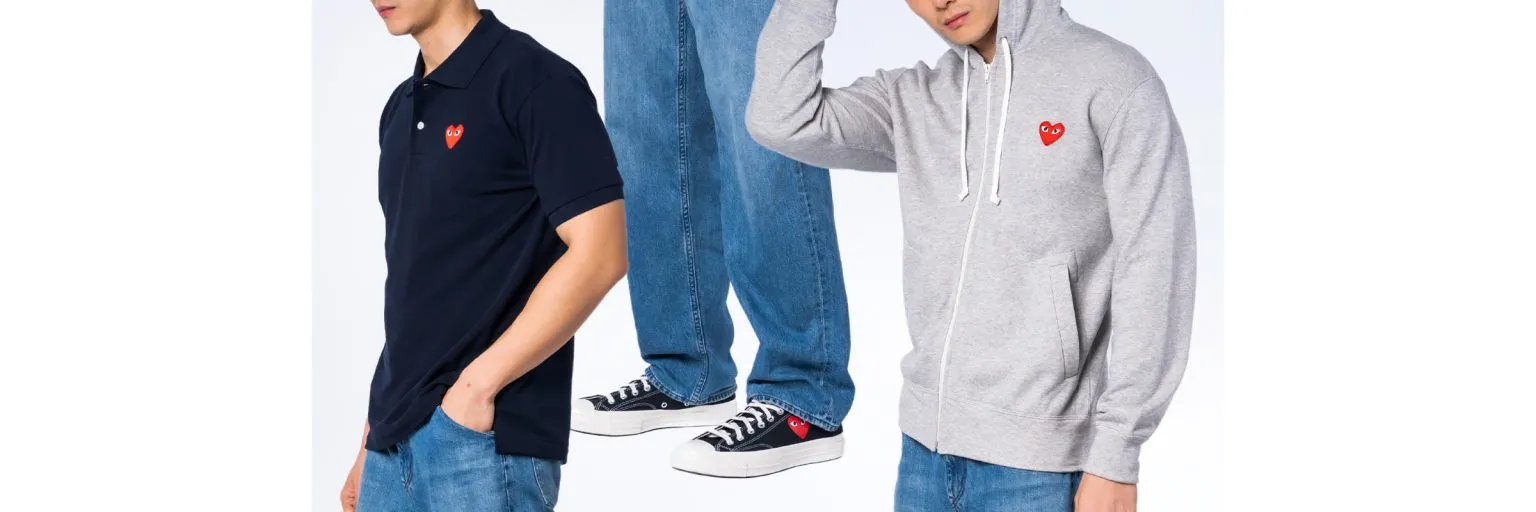
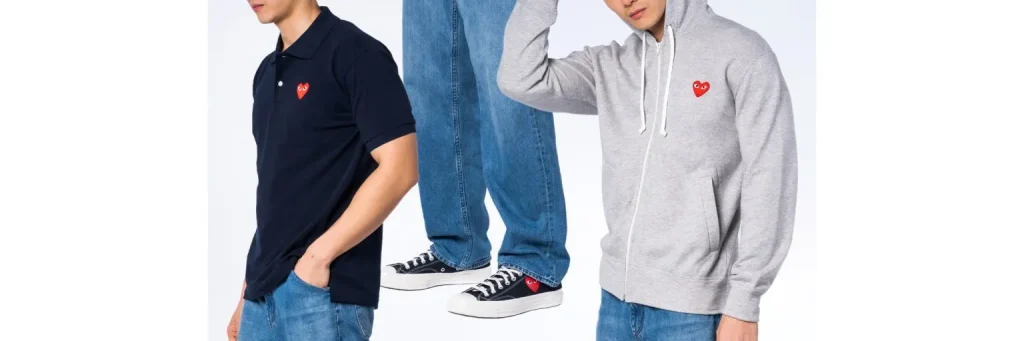
Welcome to our Japanese office, where we incorporate manufacturing discipline to help transform basic staples available in the U.S. market. When engineering the CDG Gold Heart Tee, we focus on the mechanical issues presented with metallic thread. Casual tops in the mass market typically use loose, single-row stitching for collars, which completely fail with heavy appliques. Our gold embroidered patch on the front has a completely fixed position; therefore, they create an uneven vertical sag on the front. As a solution for this particular type of front sag, we secure our crewnecks using a high-density, twin-needle stitching technique. This advanced technique holds the ribbed neckband in place to the shoulder seams, creating a flat and non-sagging neck.
Managing Metallic Thread Friction: Frankly, Pagowski’s interlocked hearts are secured with micro-filaments to mitigate localized puckering and edge fray.
Anti-Torque Grain Realignment: We comb and ring-spun our cotton loops in balanced directions to eliminate post-wash long-axis distortion and prevent twisted side seams.
High-Density Twin-Needle Top-Stitching: Preventing Neckline Seam Damage from Metallic Emblem Drag
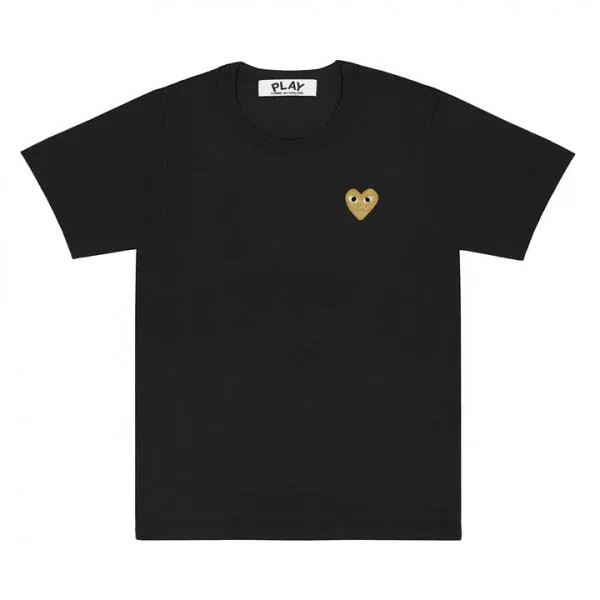
Welcome to our garment engineering hub in Tokyo. This is where we build advanced versions of casual apparel that can be found in the U.S. market. One of our signature pieces, the CDG Gold Heart Tee, comes with its own set of challenges. Embroidery using gold metallic thread distributes weight unevenly across the fabric. This is problematic because, unlike other mass market shirts that use cheap collar bands, our gold threads do not have any flexibility and sag down the front torso panel. To combat the mechanical pull of multiple embroidery patches, we reinforce our crew necks with high-density, twin-needle top-stitching. This firm attachment of collar ribbing to the shoulder seams results in a sag-free, flat framework.
Heavy-Gauge Japanese Cotton Jersey: The dense, tightly spun loops of our fabric result in an opaque layer that is self-supporting and prevents distortion of the fabric and chest puckering from the heart emblem.
Anti-Torque Side-Seam Realignment: Distortion of the fabric along its long axis is prevented by the mirrored tension of the yarn loops we utilize, ensuring that our hemlines remain straight after washing.
Managing Metallic Thread Friction: Heavy Gauge Japanese Cotton Jersey Puckering Patch
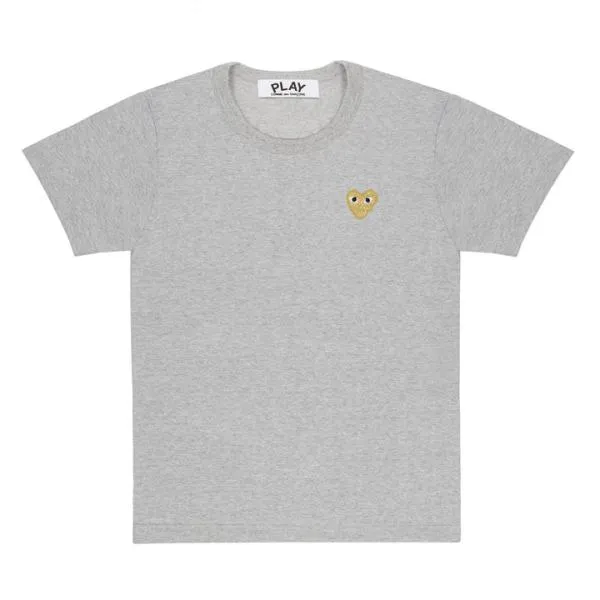
Let us show you how the Tokyo design philosophy can lead to the creation of American casualwear basics. When we design the CDG Gold Heart Tee, we study the intricacies of metallic foil embroidery and its relation to fabric. Unlike the bulk of the mass market, we start with 4oz blanks. High-luster metallic threads are stiff and abrasive. When embroidery is done on lightweight knits, the threads cause friction which leads to the cotton pulling and puckering. To completely remove left-chest dimpling, we use a heavy gauge cotton jersey from Japan. This fabric’s density and opacity provides a supportive framework for multiple patch pulls.
Twin Needle Collar “Flat” Crew Neck: Our crew neck has a bound collar rib which helps maintain a flat collar and prevents sagging.
Anti-Torque Side Seam Alignment: We achieve a straight hem by counteracting the tension on the loops of the yarn which eliminates twisted fabric.
Dimensional Knit Stability: Counteracting Metallic Filament Shrinkage and Long-Axis Fabric Twisting
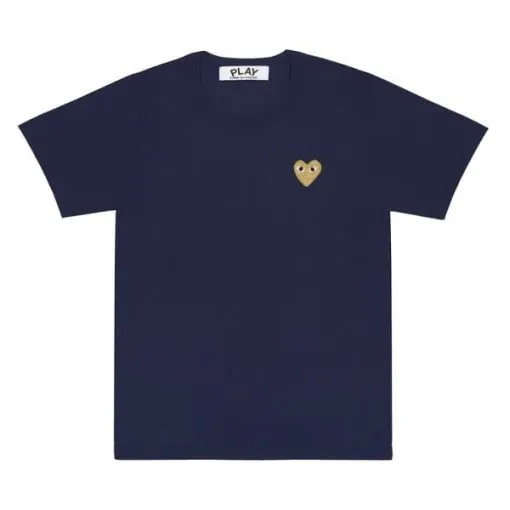
Thank you for joining our textile engineering seminar. Through intentional design, we have refined the everyday garments of the US and applied our methods to our line of Tokyo-based casual wear. When we set out to create the CDG Gold Heart Tee, we sought to eliminate a major flaw in the majority of mass-produced street wear: post-wash uneven shrinkage. Most retail blank tees and sweats are made from low-grade cotton, and the fabric experiences significant shrinkage from thread contraction. When combined with heat, the cotton shrinks and causes the fabric to twist and side seams to pucker due to the long-axis torsion.
Counteracting Metallic Thread Friction: Filip Pagowski’s design of overlapping hearts is secured with a micro-stitch profile, eliminating fraying and also preventing left-chest dimpling.
Twin-Needle Collar Construction: A ribbed bound crew neck is built to maintain the shape of the neck, preventing sag.
Gold-Heart Sizing Geometry: Comparison of Tailoring Practices from Tokyo to American Casual
Welcome to our pattern-cutting studio, where high-end Tokyo design meets the American wardrobe. We’ve designed the silhouette of our luxurious CDG Gold Heart Tee to reflect the Japanese way of thinking, bypassing the boxy and oversized styles of Western apparel. Streetwear brands rely on American vanity sizing, creating oversized, low drop shoulder styles. We abolish this design by using high armholes, drop shoulders, and clean sleeve design. This geometry focuses on draping the tee and provides a clean surface to showcase our chest emblem.
Managing Metallic Thread Friction: Chest Emblem Pagowski’s design uses overlapping hearts. We lock them in place with a micro, flat filament to avoid localized fabric pulls and dimples on the chest.
Twin-Needle Collar Architecture: a fully bound collar rib protects against sagging and pulls due to the tension of multiple patches on the neck.
FREQUENTLY ASKED QUESTIONS (FAQ)
Q: What is the difference between the cotton used for the CDG Gold Heart tee and the cotton used for other standard CDG t-shirts?
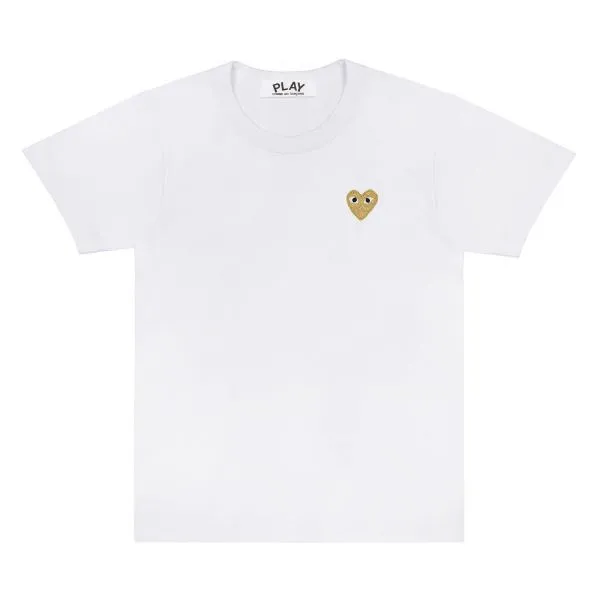
A: CDG Gold Heart tees use heavy-gauge Japanese cotton because that’s how we create dense cotton layering to support our tees. The CDG Gold Heart tee has metallic foil embroidery which can be rigid. If we were to use thin cotton for our tees, this embroidery would create friction against the cotton and would cause the cotton to warp and pull away from the design. The Gold Heart tee’s very thick cotton allows us to withhold the tension and maintain the flatness and integrity of the design.
Q: How do you maintain the metallic luster of the gold heart emblem throughout your production process?
A: We avoid cheap mass production which can compromise the quality of the product. That type of production often uses thin threads with a high rate of mass production machine embroidery which can lead to threads breaking and the emblem becoming damaged. We avoid this by using a lot of small, thin, stable threads, which hold the design and maintain the edges and the luster of the emblem.
Q: What engineering prevents the gold emblem shirts from twisting and skewing after being washed?
A: Skewing and twisted hemlines after washing are a result of uneven tension during the cotton yarn manufacturing process. Disproportionate loops wash and dry unevenly and contract differently. Coupled with a rigid and inflexible synthetic backing that holds a graphic, the yarn’s loops will yield a twist lock. This twist lock effect is also exacerbated with a post wash tortion along the long axis of the fabric. Our solution involves a process that keeps a perfectly square torso on our shirts while also neutralizing the long axis torsion. This is accomplished by utilizing a premium jersey from Japan and a preshrinking and setting process that gives us perfectly balanced and mirrored tension.
Q: I live in the United States. What specific size should I purchase for a clean fit?
A: All our apparel goes away from the boxy and oversized clothing of the American market and is inspired by the narrow high-armhole Japanese market, especially in Tokyo. Because of this inspiration, our Japanese and especially our Tokyo customers have a more tailored fit and therefore our customers in the USA should buy one size up. So our customers in the US that wear a Medium should wear a Large.
Q: What are the proper laundering guidelines to prevent the metallic thread from puckering?
A: To care for your metallic threads, wash inside out. This reduces the friction that can damage the threads and the foil. Use a cold and gentle cycle. Lay it flat to air dry. Do NOT use the dryer. The combination of heat and tumbling will cause the cotton to shrink faster than the metallic threads which will cause pucker that can be permanent.