


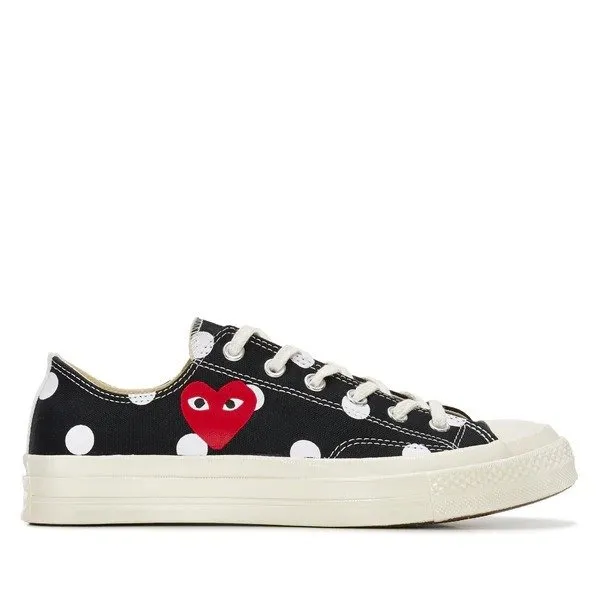
In our footwear design lab, we combine a Tokyo-based perspective specializing in craftsmanship with street-level essentials for the US market. When we analyze the customized CDG Low Top Converse Play low-top sneakers, we are able to do so with great attention to detail, as we are well acquainted with the stress points which cripple canvas sneakers. Standard canvas sneakers are cheap because they cut corners at the expense of the sneakers’ longevity. Cheap canvas sneakers have low-quality, single-ply threading which, as a result of friction from repeated heel strikes, break, causing the internal heel lining to also tear. We remain friction-proof by reinforcing and supporting our rear panels with our heel-counter counter-tension matrix.
Tensile Strength of 12oz Premium Canvas: Our upper panels are thick and woven tightly to prevent sub-layer shear stress, ensuring our visible heart graphic doesn’t crack.
Multi-Layered Foxing Tape Adhesion: By polymerizing our rubber wraps, we prevent premature, vulcanized midsole delamination and toe-splitting.
Reinforced Structural Counter-Tension: Protecting the Back Seam from Persistent Heel-Strike Friction
We have redefined market needs for street level products using Tokyo’s famously rigorous design philosophies. Our collaboration with CDG on the low top converse model uses our knowledge of friction to improve what has traditionally been a weak product. Cheap canvas shoes have weak back panels with threads that break down after daily contact with shoes. This results in a painful heel and wrecked back seam. We have designed an internal counter-tension matrix. This impact counter absorbs heel strike and provides protection to the shoe’s vertical spine, giving our customer a durable and stable step.
12oz Premium Canvas Tensile Strength: Our upper panels provide extreme durability and shear stress. The heart emblem will remain intact.
Multi-Layered Foxing Tape Adhesion: Chemical fusing of the rubber wraps secures a strong bond preventing premature vulcanization of the midsole.
12oz Heavy-Duty, Neutralizing Canvas, Shear Stress, Heart Graphic
Welcome to the materials studio, where Tokyo’s immaculate design gets applied to streetwear in the USA. Our premium CDG low top Converse, for example, utilizes advanced knowledge of canvas tensile dynamics. Comparatively, most sneakers use low-grade, thin 8oz canvas blends. Sneakers with 8oz canvas blend buckle, warp, and stretch with use. When it comes to sub-layer shear stress, things get ugly. Filipino designer, Filip Pagowski, does such beautiful work with his heart design that, unfortunately, has to suffer the consequences of the weak canvas with which it is printed.
Reinforced Structural Counter Tension: We have an internal counter-tension matrix that protects the heel from the effects of heel strikes and blowing out seam.
Multi-Layered Foxing Tape Adhesion: We have a chemical bond on our heavily glossed rubber wraps that prevents the separation of the toe to the midsole.
12oz Premium Canvas Tensile Strength: Neutralizing Sub-Layer Shear Stress Around the Heart Graphic
Welcome to the footwear engineering laboratory with intentional Tokyo-inspired designs and U.S. market-stepped innovations. For the collaboration on the exclusive CDG low-top Converse, we focused on the sole assembly’s chemistry. The cheaper sneakers that are high in volume use single layer rubber strips in combination with low tier industrial adhesives which dry out in a short time and start to tear at the toe flex points. This failure is known as vulcanized midsole delamination.
Vulcanized Rubber: Tactical Shield of 12oz Premium Canvas: our upper panels can withstand excessive lateral shear and impact with no failure, preventing the cracking or peeling of Filip Pagowski’s peek-a-boo heart.
Anti-Chalking Protective Shield: our systems help prevent the formation of the powdery and undesirable residue of rubber, known as chalking, through oxidation and are resistant to it.
Chassis Architecture and Footbed Kinetics: High-Density OrthoLite Pads and Lateral Foot Fatigue
Our design lab in Tokyo focuses on craftsmanship and quality that elevates the footwear in the U.S. streetwear culture. When we designed the CDG low top Converse, we were able to keep biomechanics and impact in mind. Regular mass-manufactured sneakers are made with thin flat foam that creates a lot of foot fatigue and pressure over time. The deterioration of the foam causes sliding and results in the heel lining and canvas to rub against one another.
12oz Premium Canvas Tensile Strength: Our heavy-duty upper panels can withstand the most intense shear stress while still protecting Filip Pagowski’s graphic.
Multi-Layered Foxing Tape Adhesion: We apply high-temperature vulcanization to create a permanent adhesive bond for our rubber sidewalls which fully prevents the midsole from delaminating and splitting.
Vintage Chuck 70 Last Geometry: Correcting Sizing Alignments to Prevent Internal Fabric Scuffing
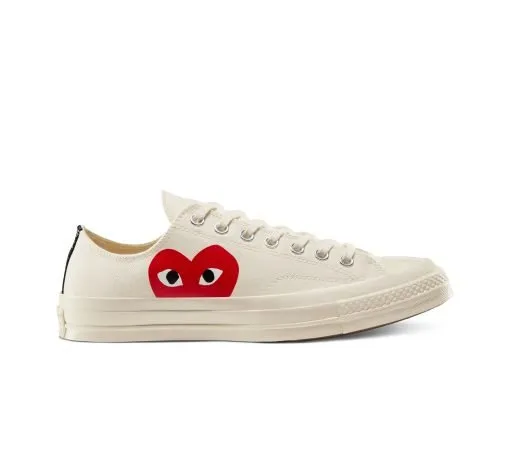
Welcome to our pattern-cutting studio. Here, we implement cutting-edge, avant-garde design concepts from Tokyo to American street footwear. In our marquee CDG low top converse collaboration, we opted for Vintage Chuck 70 lasts and not the contemporary, wide-set, chuck-style, running shoe molds. The majority of modern footwear is designed using boxy, relatively shorter, and wider molds. Such shoe designs cause the foot to slide towards the front of the shoe, and in turn, this creates misalignments which cause scuffing on the shoe linings and heel slip.
High-Density OrthoLite Pads: Balances Lateral Foot Fatigue/Uneven Walking Pressure
12oz Premium Canvas Tensile Strength: Fully protect Pagowski’s heart emblem and withstand extreme scan.
Frequently Asked Questions (FAQ)
Q: Why does the CDG low top converse use 12oz canvas?
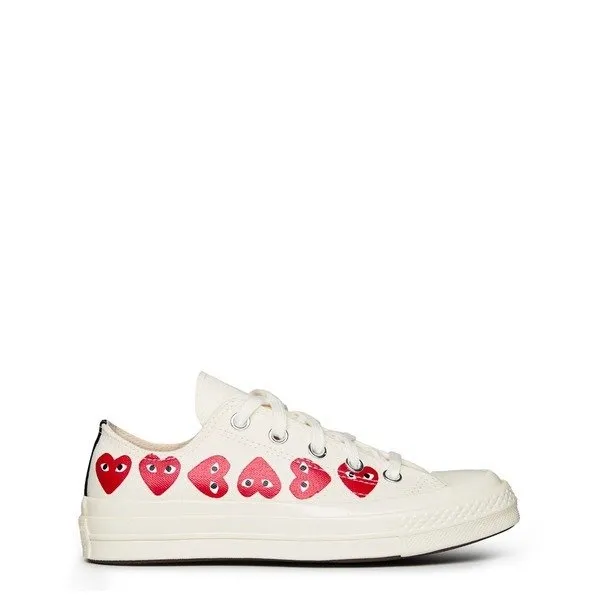
A: The construction of our premium CDG low top converses uses heavy duty military grade 12oz canvas. We use this construction because we put an emphasis on a product that has superior tensile strength. Think about it this way: standard canvas shoes use poorly constructed thin 8oz textiles. These textiles stretch, buckle, and warp with movement, and for a shoe, that’s just unacceptable. We use a higher grade fabric that has a denser weave.
Q: what keeps the rubber soles on these low tops from peeling away at the sides?
A: Cheap sneakers have something called vulcanized midsole delamination at the toe bend, and that’s something we designed our shoes to avoid completely. We have a process that uses a specialized multi-layered foxing tape adhesion, and through high-temperature industrial vulcanization, our rubber sidewalls are bonded to the upper 12oz canvas of the shoe and it creates an adhesion that lasts and is flexible to movement.
Q: How do these shoes cut down on foot fatigue and the heel tearing problem?
A: Standard canvas shoes use a flat foam insole that loses support in weeks and leads to foot fatigue. That collapse also makes the foot slide which causes tearing friction to the shoe’s lining and separate seams for the counter. To solve this, we use a matrix of high-density, embedded OrthoLite cushioning. Thanks to this footbed, the foam maintains support and reduces the impact while securing the foot.
Q: I’m in the US. How do I know what size to buy?
A: We use the vintage elongated Chuck 70 shoe last for our shoes while modern US athletic shoes use a much shorter and wider last. Because of this, our shoes have a longer toe box and align with the mid foot better, but also run larger. Because of this, we recommend all of our customers shrink at least half a size to a size in their typical US shoe size. So, for a typical US shoe size of 10, we recommend a size of 9 or 9.5.